The Meat Grinder
by chuckofish
Last Tuesday, September 15, marked the seventy first anniversary of the Marine Corps’ landing on Peleliu, an island in the Pacific about 500 miles east of the Philippines. High command reckoned the operation would take 3-4 days, but in the end it took more than two months and cost over 8,000 Marine casualties (dead and wounded). Of the 10,700 Japanese defenders, only 19 soldiers surrendered; the rest died. Peleliu introduced Eugene Sledge, who wrote the wonderful memoir, With the Old Breed on Peleliu and Okinawa, to the grim realities of war.
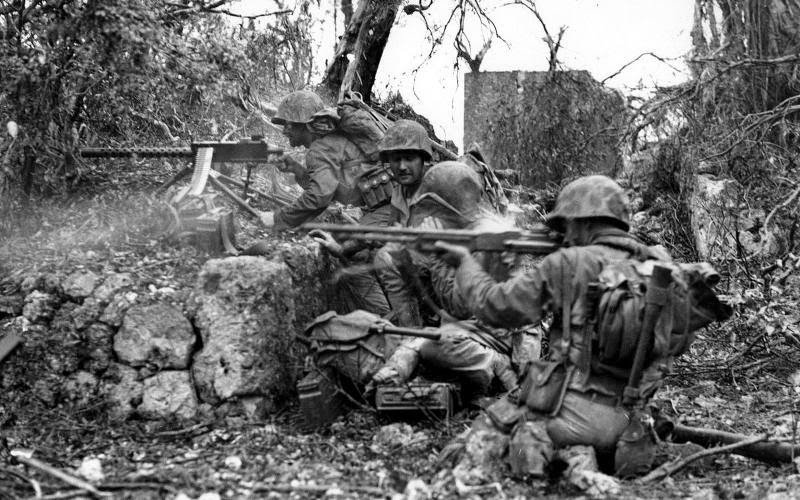 The conditions on the island were unbelievably brutal. Temperatures rose to 115 degrees, water was scarce, and many Marines succumbed to heat exhaustion. Unburied Japanese corpses putrefied and rotted. Flies that fed on the corpses and then the Marines’ rations spread disease, so that almost everyone suffered from diarrhea. But the hard coral ground made digging impossible and all waste stayed on the surface. Rest became impossible, since at night the Japanese infiltrated the Marine positions and attacked them with knives, swords, or grenades. Under these conditions, men tended to abandon all vestiges of civilization. After recounting one incident, in which a Marine attempted to extract gold teeth from a wounded Japanese soldier, Sledge wrote,
Such was the incredible cruelty that decent men could commit when reduced to a brutish existence in their fight for survival amid the violent death, terror, tension, fatigue, and filth that was the infantryman’s war. Our code of conduct toward the enemy differed drastically from that prevailing back at the division CP (p. 120).
He then went on to emphasize that
To the noncombatants and those on the periphery of action, the war meant only boredom or occasional excitement; but to those who entered the meat grinder itself, the war was a nether world of horror from which escape seemed less and less likely as casualties mounted and the fighting dragged on and on. Time had no meaning; life had no meaning. The fierce struggle for survival in the abyss of Peleliu eroded the veneer of civilization and made savages of us all. We existed in an environment totally incomprehensible to men behind the lines — service troops and civilians (p. 121).
I highly recommend Sledge’s book, which is one of the truly great war memoirs. If it is not immediately available to you, take five minutes to listen to him. He was a scholar and gentleman.
After the war, Sledge became a professor of Biology at the University of Montevallo in Alabama. He died in 2001. I’ll save his experience on Okinawa for another post.
This weekend let’s be grateful for the sacrifice of others. And remember, Tout va bien!
 dual personalities
Excellent and stirring post— eeewww.
The shame of it is that the battle for Peleliu ultimately became irrelevant from a strategy standpoint. Originally intended to seize the airfield on Peleliu in a quick battle to protect the flank of MacArthur’s upcoming invasion of the Philippines, MacArthur went ahead anyway with his invasion while the battle of Peleliu was still being fought and the airfield never played any role in the Philippine campaign. Peleliu itself had no strategic value of its own. You gotta wonder what they were thinking when they put all these lives on the line!
As I understand it, Halsey’s assessment that the campaign was unnecessary got to Nimitz after the ships were already en route and he decided it was too late to call it off. But while the campaign did not fulfill its strategic purpose, the Marines learned a lot after encountering an unexpected Japanese defense in depth. After Peleliu, they were better prepared for Iwo Jima and Okinawa.
Good point!