What are you reading?
by chuckofish
I have been reading Oscar and Lucinda by the Australian Peter Carey, winner of the Booker Prize in 1988. It tells the story of Oscar Hopkins, an Anglican priest, and Lucinda Leplastrier, a young Australian heiress who buys a glass factory. They meet on a ship going to Australia and discover that they are both gamblers, one obsessive the other compulsive. Lucinda bets Oscar that he cannot transport a glass church from Sydney to a remote settlement.
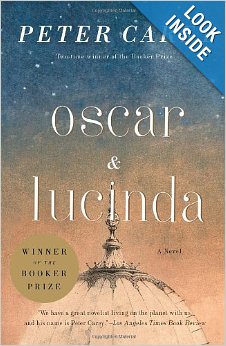
I have been reading it slowly, appreciatively, with care. Because it is SO good.
The writing is excellent. The characters are wonderful. Oh my. All of the characters, even the most minor, are drawn with fine, detailed strokes. I care so much for the two main characters, Oscar and Lucinda.
“Our whole faith is a wager, Miss Leplastrier. We bet–it is all in Pascal and very wise it is too…we bet that there is a God. We bet our life on it. We calculate the odds, the return, that we shall sit with the saints in paradise. Our anxiety about our bet will wake us before dawn in a cold sweat. We are out of bed and on our knees, even in the midst of winter. And God sees us, and sees us suffer. And how can this God, a God who sees us at prayer beside our bed…I cannot see,” he said, “that such a God, whose fundamental requirement of us is that we gamble our mortal souls, every second of our temporal existence…It is true! We must gamble every instant of our allotted span. We must stake everything on the unprovable fact of His existence.”
…”That such a God,” said Oscar, “knowing the anguish and the trembling hope with which we wager…That such a God can look unkindly on a chap wagering a few quid on the likelihood of a dumb animal crossing the line first, unless…unless–and no one has ever suggested such a thing to me–it might be considered blasphemy to apply to common pleasure that which is by its very nature divine.”
Religion in the novel is not absurd. There is a pattern in everything.
The book is composed of 111 short, titled chapters (like in Moby-Dick), each a self-contained episode, each one a testimony to luck.
I find myself constantly scribbling in the margins–I read with a pencil at hand–and underlining passages. I have not been so excited since I discovered Willa Cather last year!
She had judged him too hastily. This was a bad habit. It had caused her trouble before. She had compared him to Dennis Hasset and had pursed her lips when he picked up his tea-cup a certain way, or placed the pot back on the table a little too heavily. She had felt slighted when he had scurried back into his room and shut the door on her. And yet–how quickly it happened–she had come to be proud of the propriety with which they now shared a house, the sense of measured discipline (a virtue she much admired) that they brought to their conduct so that there was great closeness, the closeness of intimates, but also a considerable distance, the distance not of strangers, but of neighbors. They occupied a position well above the Philistines who snubbed and slighted them. God, who saw all things, would not find their conduct unbecoming.
My oldest friend, who has similar taste in literature, has suggested I read The Siege of Krishnapur by J.G. Farrell, which won the Booker Prize in 1973.
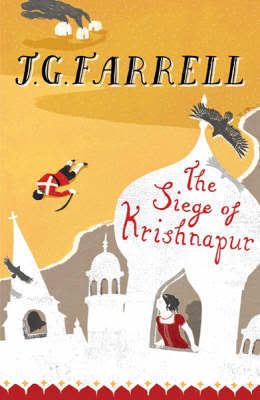
She is trying to read Booker prize-winners she has missed over the years, which is a great idea, and one I may embrace.
Another friend handed me a copy of Barbara Kingsolver’s new book Flight Behavior.
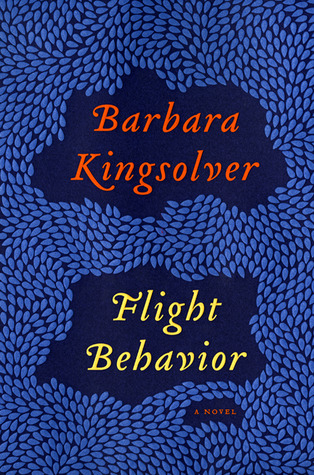
Since I have it in my hot little hand, it will probably be next on my list, although BK tends to be too political for me. I’ll give it a try.
What are you reading?
 dual personalities
Barbara Kingsolver=DePauw grad!
I know! 😉
Currently, I’m reading a Scottish murder mystery by Gordon Ferris called the Hanging Shed. It takes place in postwar Glasgow (the Gorbals) and environs. It’s not great literature, but I’m enjoying it. I gave the Siege of Krishnapur to Duncan a few years back. I haven’t read it myself, but as I recall, he didn’t like it very much. I will definitely put Oscar and Lucinda on my list! I love to hear about what you are reading….
I’m reading The Last of the Mohicans for class. I’m enjoying it well enough, but still waiting to get to the *really* good stuff…
Mid-century goodness!
[…] was probably Oscar and Lucinda by Peter Carey and my subsequent discovery of Carey as an author of […]