The toughest man south of the Picketwire
by chuckofish
Sunday is John Wayne’s birthday–so you know what I’ll be doing to celebrate!
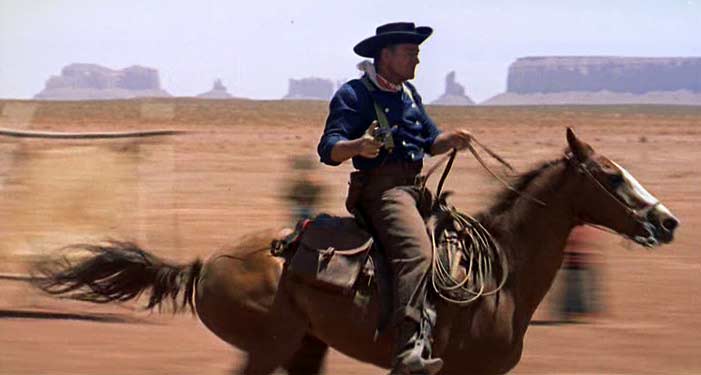
Marion Mitchell Morrison (May 26, 1907 – June 11, 1979) was born in Winterset, Iowa, but his family relocated to California when he was four years old.
A local fireman at the station on his route to school in Glendale started calling him “Little Duke” because he never went anywhere without his huge Airedale Terrier, Duke. He preferred “Duke” to “Marion”, and the name stuck for the rest of his life.
He attended Wilson Middle School in Glendale. He played football for the 1924 champion Glendale High School team. I think I read somewhere that he was president of his senior class. Of course he was. According to Wikipedia, he applied to the U.S. Naval Academy, but was not accepted. Well, their loss. Instead he attended the University of Southern California (USC), majoring in pre-law. He was a member of the Trojan Knights and Sigma Chi fraternities.
He found work at local film studios when he lost his football scholarship to USC as a result of a bodysurfing accident. Initially working for the Fox Film Corporation, he mostly appeared in small bit parts. His first leading role came in the widescreen epic The Big Trail (1930).
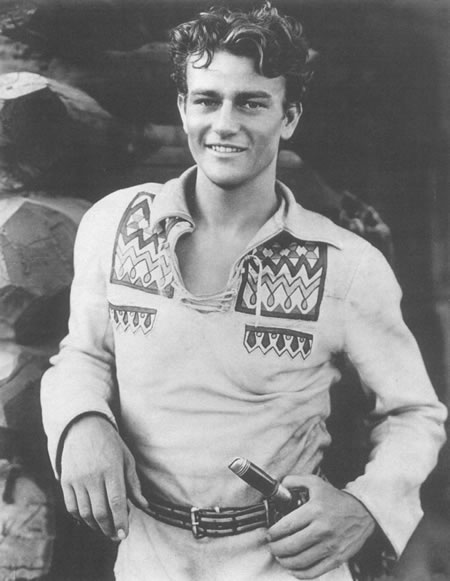
A star is born. Hello, John Wayne.
His career rose to further heights in 1939, with John Ford’s Stagecoach making him an instant superstar.
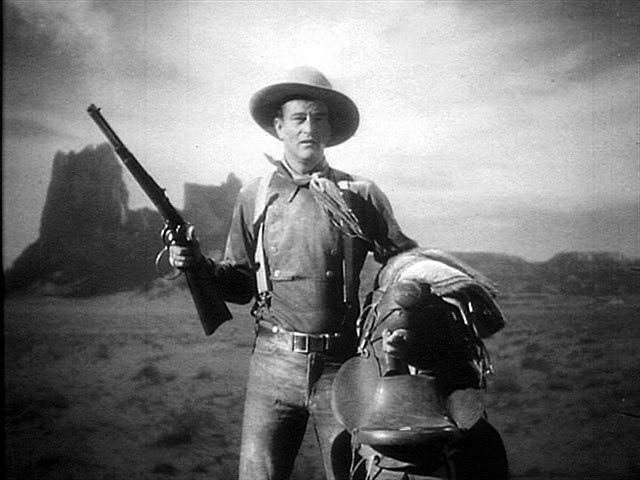
Wayne would go on to star in 142 pictures.
My “Top Ten”–make that Eleven–Best Films of John Wayne would include:
Stagecoach (1939)
3 Godfathers (1948)
She Wore a Yellow Ribbon (1949)
Rio Grande (1950)
The Quiet Man (1952)
The Searchers (1956)
Rio Bravo (1959)
The Horse Soldiers (1959)
The Man Who Shot Liberty Valance (1962)
El Dorado (1966)
True Grit (1969)
Eight of these were directed by John Ford. What a great team! Has there been another like it in film history? I think not.
Three of these would be on my “Ten Best Movies of All Time” List.
There are so many other really good movies which do not make the top eleven, but are eminently entertaining. Consider:
Tall in the Saddle (1944)
Fort Apache (1948)
Red River (1948)
Sands of Iwo Jima (1949)
Hondo (1953)
Blood Alley (1955)
Legend of the Lost (1957)
The Comancheros (1961
Hatari (1962)
How the West Was Won (1962)
Donovan’s Reef (1963)
The Sons of Katie Elder (1965)
The War Wagon (1967)
The Cowboys (1972)
The Shootist (1976)
John Wayne is great at all ages, in all decades of his stardom. I contend that even a bad movie with John Wayne is entertaining and worth watching. And I always feel better after I’ve watched one.
I grew up watching John Wayne Theater on Saturday/Sunday afternoons. My parents were both John Wayne fans so we always went to the movies to see his newest film. The first “new” John Wayne movie I went to see at the movies was El Dorado. My mother was back east visiting her dying mother, so our father took my dual personality and me to see it. I’m sure if my mother had been home, we would have been deemed “too young”, but my father wanted to go, so he took us along. It was the summer after fifth grade (second grade for my sister!). It was so great. When I went home I looked up the poem “El Dorado” by Edgar Allan Poe and memorized it. I still know it by heart. Quelle nerd, I know.
When I was a graduate student at the College of William and Mary, John Wayne came to town to tape an appearance on the Perry Como Christmas Special. It was late in 1978. Completely out of character, I went down to Colonial Williamsburg, armed with my Kodak Instamatic, hoping to catch a glimpse of the Great Man. My guardian angel was with me that day. I ran into my hero coming out of one of the colonial shops. A small crowd was forming but people were respectful. I snapped a picture (where is it?!)–he was standing a few feet away. I started to cry. I could cry now writing about it. It’s silly, but it was just so great. He was very tall. He was kind and patient and smiled at everyone, even though he clearly was not well. He died the following June.
John Wayne’s enduring status as an iconic American was formally recognized by the U.S. government by awarding him the two highest civilian decorations. He was recognized by the United States Congress on May 26, 1979, when he was awarded the Congressional Gold Medal. Hollywood figures and American leaders from across the political spectrum, including Maureen O’Hara, Elizabeth Taylor, Frank Sinatra, Mike Frankovich, Katharine Hepburn, General and Mrs. Omar Bradley, Gregory Peck, Robert Stack, James Arness, and Kirk Douglas, testified to Congress of the merit and deservedness of this award.
On June 9, 1980, Wayne was posthumously awarded the Presidential Medal of Freedom by President Jimmy Carter, at whose inaugural ball Wayne had appeared “as a member of the loyal opposition,” as Wayne described it in his speech to the gathering.
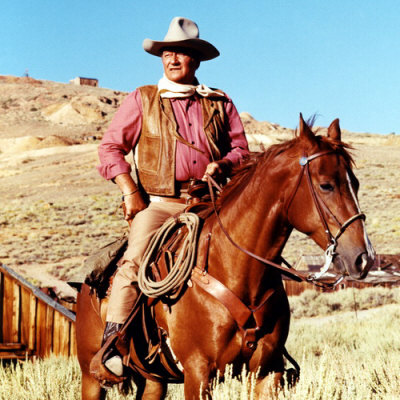
So I know what I’ll be doing on Sunday–honoring old John Wayne by watching some of his movies. What is your favorite John Wayne movie?
Here’s a nice tribute TCM did with Harry Carey, Jr. (By the way, they are showing a whole slew of John Wayne films on Sunday starting at 6:45 a.m.–all war movies.)
 dual personalities