What the hell happened?*
by chuckofish
I am closing in on the final pages of The Sand Pebbles. This 597-page novel is really wonderful and I highly recommend it. Written by Richard McKenna, it centers on an American gunboat on the Yangtze River in 1926. The author completed it in May, 1962, just in time to enter it in the 1963 Harper Prize Novel Contest. Not only was it picked over 544 other entries for the $10,000 first prize and accepted for publication by Harper & Row, but it was also chosen as the following January’s Book-of-the-Month Club selection. It was also serialized in the Saturday Evening Post for the three issues from November 17, 1962 through December 1, 1962.
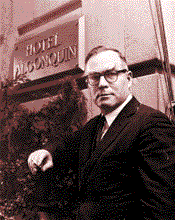
The author’s life story is not the usual back-of-the-book blurb. Enlisting in the Navy in 1931 at the age of 18, he served until 1953 when he retired after 22 years of service as a machinist’s mate. He then entered the University of North Carolina. He received his degree in English in 1956, married one of the university librarians and settled down to write. Sadly, he died in 1964 at the age of 51, but one feels that to have written his magnus opus and seen it published to acclaim is a great thing. He must have been an extraordinary man.
I am reminded of what John Steineck said about his own East of Eden: “I put everything I knew into that book.” One feels this is the case with Richard McKenna. The Sand Pebbles is full of truth. The author pours everything he has into this well-crafted, well-written story of a man struggling to understand himself and the world he finds himself in.
Jake Holman, the hero of the story, is a great character with whom many can relate:
They could command you what you had to do, he thought, but they could not command you how you had to feel about it, although they tried. So you did things their way and you felt about them your own way, and you did not let them know how you felt. That way you kept the two things separate and you could stand it.
One imagines that there is a whole lot of Richard McKenna in Jake. Toward the end of the book he describes Jake’s thoughts about Shirley, the missionary teacher: “He kept her deliberately on the edge of his dream. He would get books from her and read them and later they would talk about them. They would be friends, but she would still be just a teacher.” One can’t help thinking of the author’s courtship of the UNC librarian.
The movie, which was released in 1966, is one of my favorites and Steve McQueen is perfectly cast as Jake Holman.
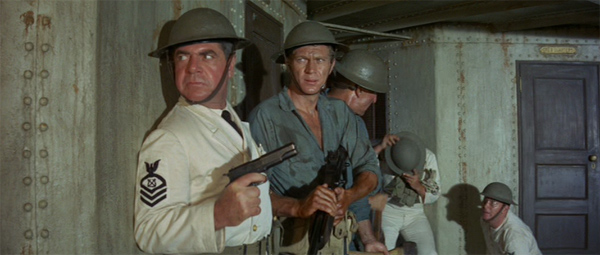
Any excuse to insert a picture of Steve McQueen in the blog is a good one.
The screenwriter did take many liberties with the story, however, which is a necessity I suppose with such a long, detailed book. In the book the sailors (the “sand pebbles”) are good guys deep down and not all are the low-lifes portrayed in the movie. The captain, also, is a good guy and not the duty-obsessed, blinders-wearing martinet portrayed in the film.
Perhaps it is better that Richard McKenna never saw it.
*P.S. No one says this in the book. Instead, Jake says, “Go to hell, you bastards!” The book is always better.
 dual personalities
The book’s last line is so much better than the movie’s!! Why did they have to go all anti-war? I guess those Hollywood types have always looked down on their audience — as if we have to be hit over the head with something and have no subtlety. Oh, well. Great post on a great book!
Actually that is Jake’s last line. The last line of the book is: “The flailing storm of lead crumpled and threw Jake Holman like a giant hand wadding wastepaper.” Which I think is pretty great.
I REALLY like the book’s dying words too!