Sing, O Muse
by chuckofish
of the Rage of Achilles.
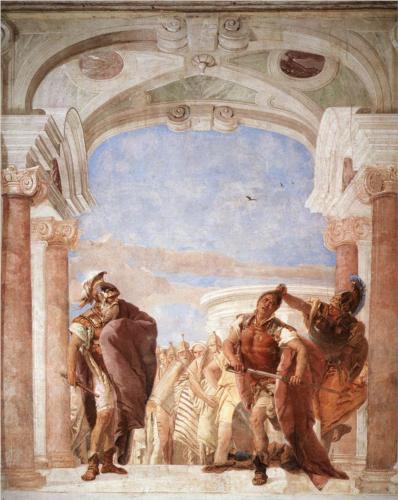
Tiepolo’s “Rage of Achilles
That’s Agamemnon looking worried on the left, while Athena (far right) tries to stop Achilles from chopping Agamemnon up into tiny pieces. I’m not sure the painting really captures the rage, but it is kind of pretty.
If your only acquaintance to The Iliad is through that ridiculous film, Troy, you can be forgiven for relegating the story to “the dustbin of history”. But I urge you to give the poem a chance. It, together with its twin, the Odyssey, ranks right up there with Shakespeare and the Bible — and it’s certainly the best war story ever.
What makes it great is its humanity. Sure, there’s plenty of testosterone-fuelled violence and, yes, the gods are interfering bastards, but there are real characters here, in real situations, to which the modern reader can still relate. I could go on and on, but today I’m going to concentrate on Achilles, who is, after all, central to the poem. The poet makes sure that Achilles is not just a dumb, sulky jerk. In fact, he gets some of the best lines, many of which point out the contradictions and difficulties inherent in war.
For example, during his argument with Agamemnon at the beginning of the poem, Achilles angrily declares that
I don’t have a quarrel with the Trojans
They didn’t do anything to me to make me
Come over here and fight, didn’t run off my cattle or horses
Or ruin my farmland back home in Pthia…
How often do soldiers find themselves wondering what their war really has to do with them? The Iliad is as conscious as we are that it’s the politicians (or in the poem’s case, kings) who start the wars and who send people to die in them, usually while they (the politicians) stand at the back. Achilles notably accuses Agamemnon of never having “buckled on armor in battle or come out with the best fighting Greeks” because it’s “more profitable to hang back in the army’s rear.” So true.
The poem also explores larger, more existential questions. In book 9, when people are trying to get Achilles to re-join the fight, he rants bitterly:
It doesn’t matter if you stay in camp or fight —
In the end, everyone comes out the same.
Coward and hero get the same reward:
You die whether you slack off or work.
In other words, life’s a bitch and then you die.
Even so, there’s a soft side to Achilles, who, in the same speech, reminds us that
Every decent, sane man
Loves his woman and cares for her, as I did,
Loved her from my heart. It doesn’t matter
That I won her with my spear.
Although it is common to assume that women in times past were horribly abused and oppressed, the poem is surprisingly appreciative of the plight of women, most of whom it is well aware will come to bad ends as a result of what men have done.
But the poem has a lighter side, too. Even the greatest of heroes were babies once. Phoenix, Achilles’ old nurse/mentor reminds the angry hero of their long-standing relationship:
You wouldn’t eat
Whether it was at a feast or a meal in the house
Unless I sat you on my lap and cut your food up
And fed it to you and held the wine to your lips.
Many a time you wet the tunic on my chest,
Burping up wine when you were colicky.
Okay, there’s also underage drinking here, but they didn’t have infant formula and wine was really the safest thing to drink…but anyway, you get the idea. Achilles was just as human as anyone else.
This poem has everything: action, adventure, plenty of conflict, lots of heart-rending emotional scenes, and a whole lot of wise things to say about human nature and war. Read it. Really. Stanley Lombardo’s translation, quoted here, is highly accessible, though it does take certain liberties. If you’re a purist, try Fagles’s or Latimore’s translations.
 dual personalities