A sonnet for Monday
by chuckofish
In my flyover institute of learning we sometimes offer a course on reading sonnets facilitated by a gentleman who really loves sonnets. I have never been a big fan of sonnets myself, in large part because when we studied them in the 6th grade, we had to write one. Good grief! What 12-year old is capable of writing a sonnet I ask you? John Keats maybe. Certainly not I. It prejudiced me against the form. Anyway, I was glancing through the syllabus the other day and came across this one.
The Cross of Snow
By Henry Wadsworth Longfellow
In the long, sleepless watches of the night,
A gentle face — the face of one long dead —
Looks at me from the wall, where round its head
The night-lamp casts a halo of pale light.
Here in this room she died; and soul more white
Never through martyrdom of fire was led
To its repose; nor can in books be read
The legend of a life more benedight.
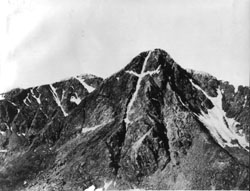
There is a mountain in the distant West
That, sun-defying, in its deep ravines
Displays a cross of snow upon its side.
Such is the cross I wear upon my breast
These eighteen years, through all the changing scenes
And seasons, changeless since the day she died.
Longfellow wrote this sonnet about his second wife, Frances Appleton Longfellow, who died after her dress caught on fire and she was severely burned. Longfellow himself was burned when he attempted to put out the flames with a rug and his own body. His face was burned and that is why, from then on, he always wore a beard.
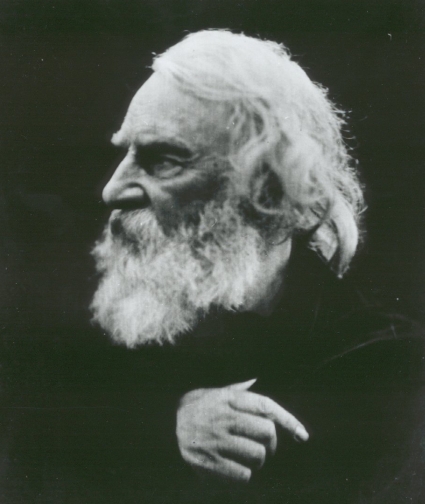
Longfellow photographed by Julia Cameron
Longfellow’s great fame faded after his death and he is mostly known today for having written The Midnight Ride of Paul Revere. However, I doubt that school children are made to memorize portions of it now or learn about meter by reciting This is the forest primeval…from Evangeline.
More’s the pity. I like this sonnet about his wife. Could I be wrong about sonnets? Look for more sonnets in this blog as we widen our appreciation together!
 dual personalities
I clearly need to spend more time with the Fireside Poets. I don’t mind sonnets, though they do represent a time when American writers were still imitating British forms and style, tsk tsk!
Also, while I don’t love modern day facial hair (“no shave November” is abhorrent to me) there’s something about the 19th century bearded bards that I just LOVE.
He is a fine looking bearded gentleman indeed.
Oh, my — mutton chops!!
This is a nice but sad sonnet. I definitely enjoyed it. I’ve always thought that mountain was verrrry cool. It’s in Colorado, right?
One thing about Bearded 19th century men is that it covers up how handsome some of them were! Look at a picture of a young Stonewall Jackson. Great looking guy.
That is why my mother never approved of my brother growing a beard–she thought his face was too handsome to cover up!
I love the sonnet — very sad and beautiful. I’m a sucker for melancholy.
Yes, indeed, aren’t we all? It is a very sad story. They say he worried he would go insane and begged “not to be sent to an asylum” and noted that he was “inwardly bleeding to death”. Considering that, it is a pretty restrained sonnet.